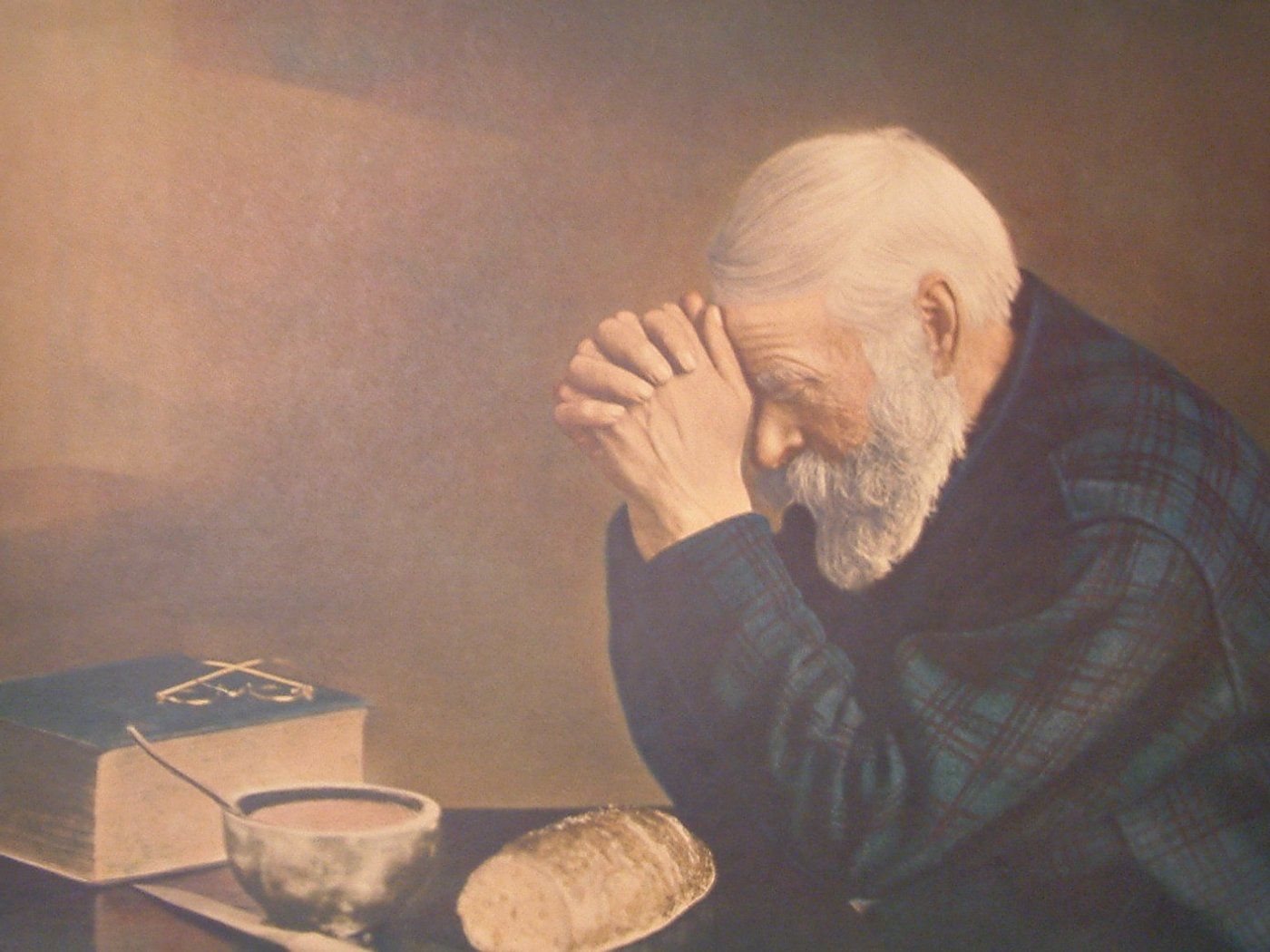
Gracious and holy Father, please give me intellect to understand you, reason to discern you, diligence to seek you, wisdom to find you, a spirit to know you, a heart to meditate upon you, ears to hear you, eyes to see you, a tongue to proclaim you, a way of life pleasing to you, patience to wait for you, and perseverance to look for you. Grant me a perfect end, your holy presence, a blessed resurrection, and life everlasting. Amen.
~ Benedict of Nursia (480-547)
Author: A Prayer Life
The Prayers of St. Paul – Pt. 1
I will pray with the spirit, and I will also pray with understanding.
~ 1 Corinthians 14:15b
I would like to take a few posts and survey some of the prayers and prayer methodology of the Apostle Paul. Paul is well-known for his fervent proclamation of the Gospel and his tireless defense of sound doctrine. But this dear saint was also a deeply devotional and passionately Spirit-filled man of prayer. With even a cursory reading of Paul’s epistles, one will find a treasure trove of guidance and instruction for their own prayer life. After studying Paul’s prayers, I might even say he is the quintessential New Testament example for believers today. My sincere hope is this series will be of spiritual profit to those who read it.
In 1 Corinthians, the 14th chapter, Paul lays out two guiding principles for his prayer life. Number one, he will pray with the spirit. Number two, he will pray with understanding. Any meaningful and moving prayer will always consist of these two elements. As for praying with the Spirit, it can be said there is no godly prayer without it. Prayers of our own making, prayers of our own strength, without the abiding and enabling help of God’s Holy Spirit are no prayers at all. We pray in the power of the Spirit or not at all. The person who seeks to bring their supplications before the Lord, must first seek and find the communion of the Holy Spirit to make their prayers pleasing and acceptable to God (Romans 8:26-27).
Second, Paul’s desire is to pray with understanding. The idea here is he will pray intelligently, with a working knowledge of how and what to pray for. This is accomplished through the ongoing cultivation of our over-all spiritual life. People learn to pray with more and more spiritual understanding as they grow in their faith and fellowship with Christ and by feasting on His Word. There are those who pray without understanding and you will find them praying in a frivolous and worldly manner. Paul’s principle of praying with the understanding is essential for growth in God and in a purposeful and fruitful prayer life.
If you find yourself struggling to know where to begin in your own prayer life, take these two fundamental principles of the Apostle Paul to heart. Prayer with the spirit and with understanding; they are so important and a prerequisite to finding fulfillment in prayer.
~ apl
The New Life Which Follows Repentance
Our Lord’s idea of repentance is as profound and comprehensive as His conception of righteousness. Of the three words that are used in the Greek Gospels to describe the process, one emphasizes the emotional element of regret, sorrow over the past evil course of life, metamelomai; a second expresses reversal of the entire mental attitude, metanoeo; the third denotes a change in the direction of life, one goal being substituted for another, epistrephomai; Repentance is not limited to any single faculty of the mind: it engages the entire man, intellect, will and affections… Again, in the new life which follows repentance the absolute supremacy of God is the controlling principle.
~ Geerhardus Vos (1862-1949)
Moral Relativism & The Battle For Truth
“I am… the Truth”
~ John 14:6
The influence of a Modern, and more recently, a Post Modern worldview places a premium on the relative nature of truth. According to those who embrace Post Modernism, truth is largely a particular construct of the individual based on their immediate circumstances. So that, what may be true one moment and in one context, may cease being true in the next. Both Modernism and Post Modernism came about as a result of the Enlightenment and was a product of the 17th & 18th century Age of Reason. Consequently, this shift from objective to subjective truth has adversely effected the faith of many Christians and has lead to a rapid decline in the belief of moral absolutes and an objective standard for truth.
For example, men like Joseph Fletcher (1905-1991) who was an ordained Episcopal priest, theologian, educator, and author developed a concept known as “situational ethics” whereby the ethical nature of an act gives more consideration to such things as private ideals, individualistic values, and personal interests over and above transcendent, absolute, moral standards. Another 20th century theologian, Lutheran professor Karl Bultmann (1884-1976) promoted the philosophy of existentialism, again advocating for a strong emphasis on the immediacy of how one’s own experiences shape their beliefs about life, faith, and truth.
As a result, this moral relativism has spread, not only throughout society at large, but it has sadly taken root in the Church. We judge truth rather than truth judging us. There is a battle for defining truth. Many Christians now look more to their own personal experience for what they believe or “feel” is true rather than trusting the objective standard of Holy Scripture. Yet, it is in the Bible where we read Jesus’ powerful testimony about Himself – He is the Truth! Truth is not found in private meditation or personal reflection, truth is found in Jesus Christ alone. Christians ought not to look inward for truth, but outward and upward. Look to Jesus. That which is truth will always accord with what God and His Son has revealed to us, not what we can find delving into the depravity of our own sin-darkened hearts.
Therefore, if we find ourselves trusting too much in the “wisdom of men” or in “leaning on our own understanding”, let us repent and remember: truth is in a person, that person just isn’t ourself – it is the Lord Jesus Christ. The One who declared two thousand years ago:
“I am… the Truth”.
~ apl
The Evidence of Piety
Let Christians remember, that in a season of revival as well as in a season of coldness, the evidence of piety is to be sought in the fruits of the Spirit. And let sinners remember that no degree of attendance or means, no degree of fervor, can be substituted for repentance of sin and faith in the Savior.
~ William Sprague (1830-1915)
Our Inheritance
In [Christ] also we have obtained an inheritance…
~ Ephesians 1:11 (NKJV)
Those who are “in Christ”, that is, those who repent, believe and embrace Jesus Christ as their Lord and Savior have had promised to them a great and glorious inheritance. Though this anticipated inheritance contains many countless benefits and blessings, the greatest of them all is the eternal communion and fellowship we will enjoy with the Lord Jesus Christ Himself.
But let us not forget the very nature of an inheritance; it is only received after someone dies. First, Christ died for us (the Surety of our inheritance), and then, as we live and die in Him, we obtain that true treasure. It is an inheritance. It is not something we fully realize here and now. The blessedness of the Christian’s reward may never be completely realized this side of glory. Yet as an inheritance, promised by a loving God, it is waiting for the Faithful who die in Christ in this world, only to be raised with Him in the next.
~ apl
Great Is Thy Faithfulness
Cease Not To Rejoice
It is, indeed, certain, that all the senses of our nature are so formed, that every trial produces in us grief and sorrow; and no one of us can so far divest himself of his nature as not to grieve and be sorrowful whenever he feels any evil. But this does not prevent the children of God to rise, by the guidance of the Spirit, above the sorrow of the flesh. Hence it is, that in the midst of trouble they cease not to rejoice.
~ John Calvin (1509-1564)
We Ask You
We ask you, Master, be our Helper and Defender. Rescue those of our number in distress; raise up the fallen; assist the needy; heal the sick; turn back those of your people who stray; feed the hungry; release our captives; revive the weak; encourage those who lose heart. Let all the nations realize that you are the only God, that Jesus Christ is your Child, and that we are your people and the sheep of your pasture.
~ Prayer of Clement of Rome (c. 96AD)
What Is A Christian?
A Christian is one who recognizes Jesus as the Christ, the Son of the living God, as God manifested in the flesh, loving us and dying for our redemption; and who is so affected by a sense of the love of this incarnate God as to be constrained to make the will of Christ the rule of his obedience, and the glory of Christ the great end for which He lives.
~ Charles Hodge (1797-1878)
 A Prayer Life